Robotics Data is a Broken Business
Topics worth your time: Eidon’s post-mortem on the business of robotics data, the manufacturing and design lineage behind the Raptor 3 engine, why idle industrial capacity should be used for science, the many ways to turn human manipulation into robot training data, and learning chip design with a €50 tapeout.

Interesting Links
In a macro-landscape of irrational exuberance and constant flux, it’s difficult to tell where technical progress translates into a viable business. Or more importantly, understanding that a problem can be worth solving without being the basis for a company. A post-mortem from Eidon, a shuttered robotics data collection startup, recently made the claim that robotics data is a broken business in what reads as a cautionary tale about applying software thinking to hardware. Video-only data is commoditizing, and the more valuable data today comes from using custom collection hardware with all the constraints of deploying and supporting a physical product. That means shipping logistics, unit-to-unit sensor calibration, debugging hardware failures, and enforcing QC standards around the data itself. None insurmountable on its own, but collectively more demanding than they first appear. The more fundamental constraint is that robotics data providers may only serve a time-bound role. As the author argues, the ultimate goal of any robotics lab is to build a data flywheel, where systems deployed by the lab or its partners collect data to improve its own models. Third-party providers are the bootstrapping force behind that flywheel, but once labs can fulfill their own data needs, the need for outside collectors diminishes. More in the full write-up on the risks of short-term thinking and building simpler products. Choose hard things. Difficulty == moat.
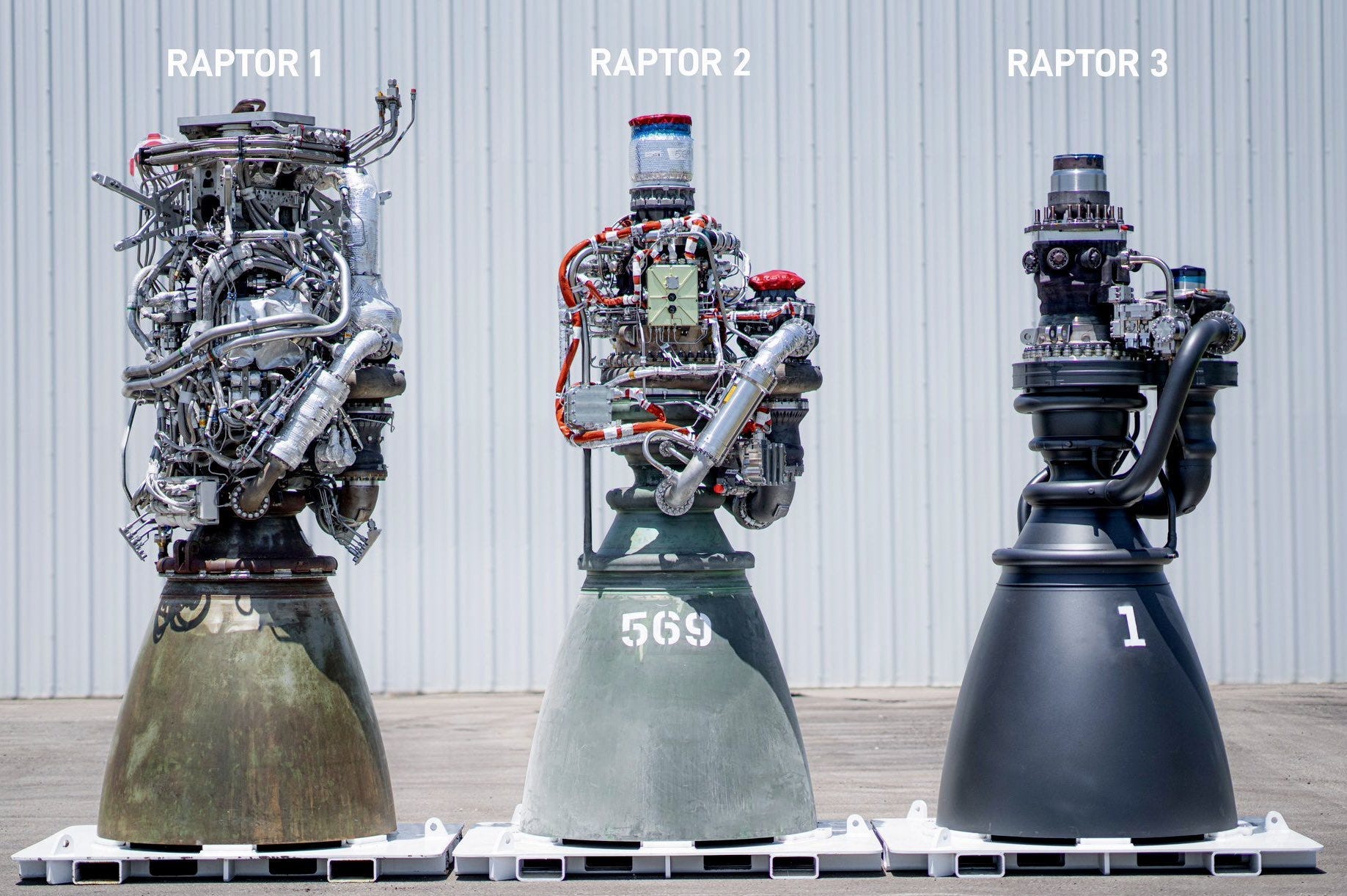
When initial images of the Raptor 3 engine were released, some believed it was partially assembled (including ULA’s then-CEO, Tory Bruno). SpaceX successfully cut so much exterior hardware that even experienced aerospace engineers questioned whether it was functional. While most of the design is closely guarded, Construction Physics has a great breakdown of the design and manufacturing work required to make “simple” possible. A quick aside on how these engines work: the more mass a rocket expels each second, and the faster it expels it, the more thrust it produces (think Newton’s 3rd Law). Feeding that process requires powerful pumps to force fuel and oxygen into an already pressurized combustion chamber. The basic sequence is to burn some propellant → spin a turbine → drive the pumps → force more fuel and oxygen into the main combustion chamber. Falcon 9’s Merlin engines burn a small amount of propellant in a gas generator to drive the pumps, then discharge the turbine exhaust separately. Raptor, on the other hand, routes all its propellant through two preburners (small combustion chambers), producing one gas stream rich in fuel and another rich in oxygen. Those gases spin the turbines that drive the pumps, then enter the main combustion chamber and burn together. Wonderful in theory, but enormously complex to get working in practice. Getting to Raptor 3 took 14 years of ground tests and early flights, followed by stripping out development sensors, consolidating valves, replacing bolted joints with welds, and using metal 3D printing to move external plumbing inside components. (See above: Difficulty == moat.)
Before Raptor, there had been only two major efforts to develop full-flow staged combustion engines: the Soviet RD-270 in the 1960s and the US Integrated Powerhead Demonstrator in the 1990s and 2000s. Neither flew, and the US program never produced a complete engine.
When private institutions lend excess industrial capacity to scientific pursuits, we all benefit. For example, the Holmdel Horn at Bell Labs was originally built to receive radio signals from a comms satellite in the 1960s; when newer satellites made it obsolete, two researchers repurposed the antenna to study radio signals from space. What they found instead was cosmic background radiation, providing strong evidence for the Big Bang and earning them a Nobel Prize in Physics—all from investigating the noise instead of the signal they were looking for. Even today, few researchers and public institutions have access to land, large equipment, and machine shops. And large private companies often lack the bandwidth and funding to dedicate to research without near-term commercial payoff. Putting the two together gives researchers access to hardware they couldn’t otherwise afford, and gives idle industrial capacity a useful second life.
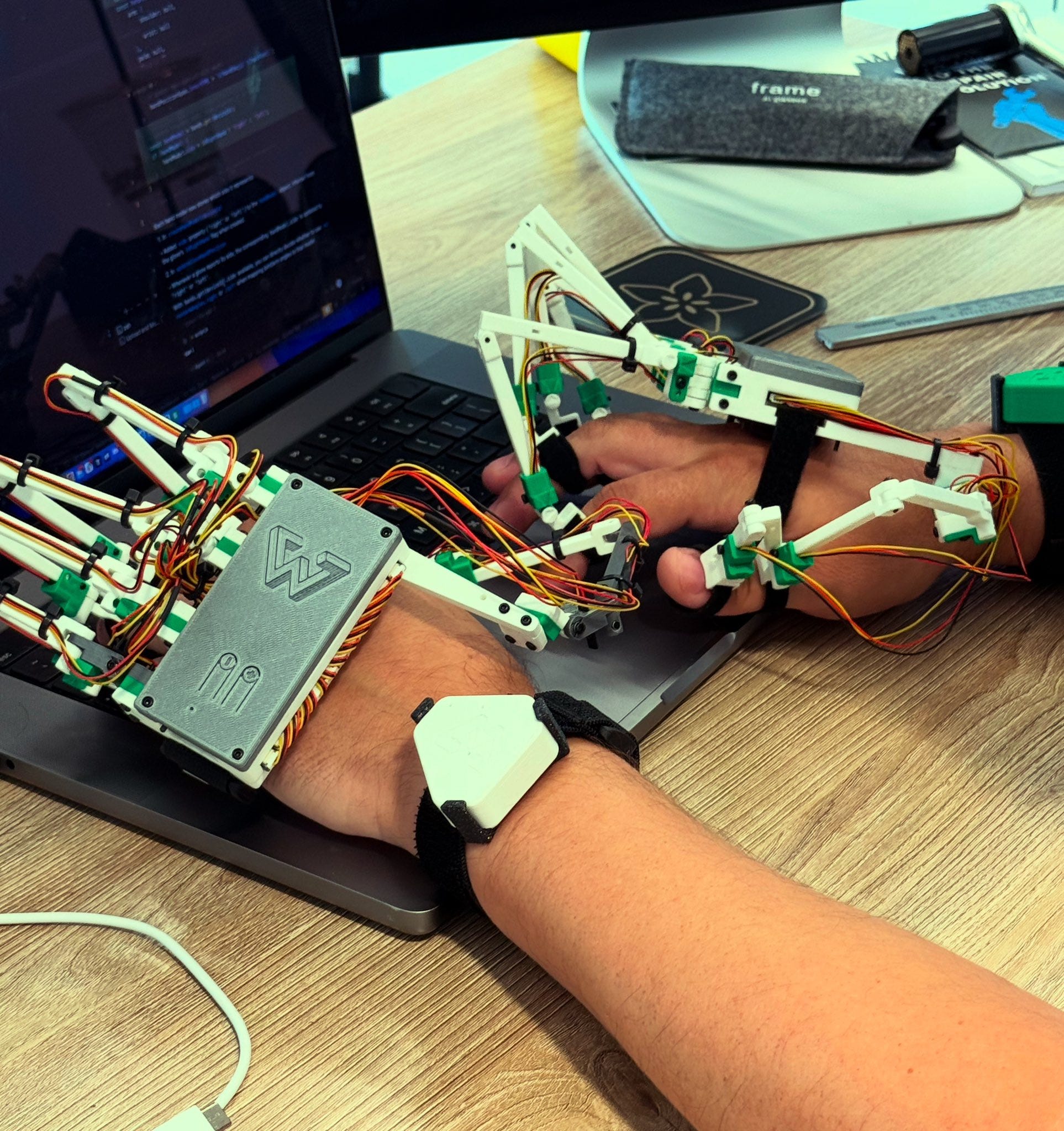
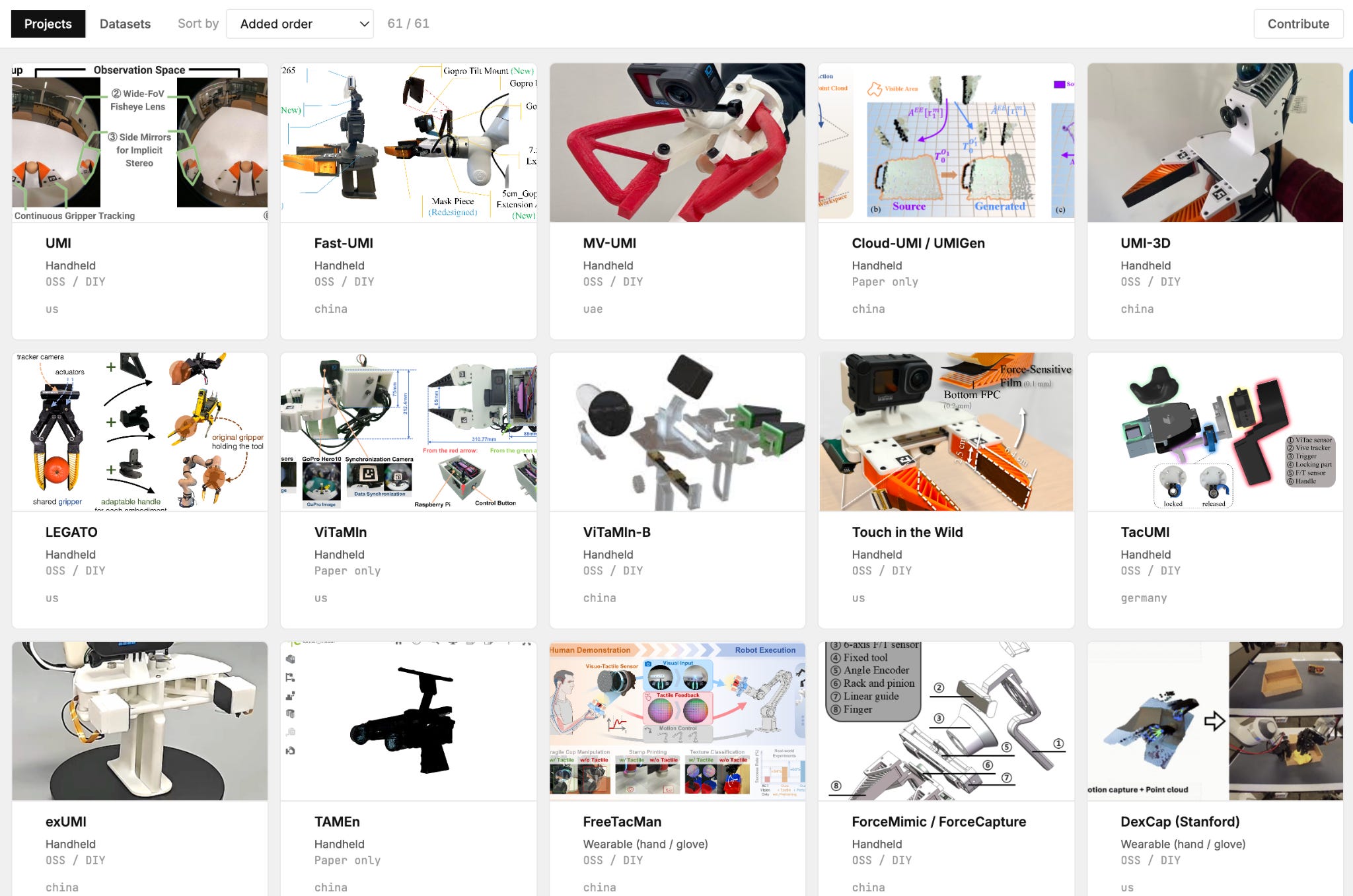
What better way to get up to speed on the Wild West of Universal Manipulation Interfaces (UMI) than by seeing the dozens of differentiated approaches people are taking to turn a human hand into a robot hand? Awesome UMI is a collection of 61 projects and relevant datasets around robotic data collection frameworks. At face value, creating training examples for robots works best when the interface can do two things: 1) closely approximate robot kinematics, and 2) allow a human to reliably complete everyday tasks. Teams that design the best hybrid human-robot hands stand to gain a massive data collection advantage. However, this is a fraught design space in which optimizing for one goal is, almost by definition, de-optimizing the other. Fully dexterous, anthropomorphic robot hands are not yet reliable, strong, or sensitive enough to justify relying purely on vision-based hand tracking. Replicating human dexterity introduces severe mechanical liabilities: more motors, linkages, and tendons mean vastly more points for friction, fatigue, and failure.
Tiny Tapeout’s Matt Venn on how to address the semiconductor talent shortage. His initiative gets the cost of a tapeout down to €50, allowing students a chance to learn by doing—and have playful experimentation with chip design before committing to a career in it. Full slides here.
A couple fun links to round out the week:
As engineers, we don’t spend much time thinking about org structure (we have things to build!). Mind Robotics makes a useful case for why it matters to the work itself, and what running a flat org means.
The masonry skew arch. Related: a research paper on how skew angle affects its mechanical behavior.
And some events on the horizon:
Instrumental is hosting their 3rd annual Build Better Electronics Summit, bringing together 300+ electronics engineering and operations leaders across AI infrastructure, consumer, and aerospace & defense. Expect a senior audience for candid conversations, cross-industry learning, and meaningful networking around today’s toughest manufacturing challenges, all aboard the USS Hornet aircraft carrier! Learn more and register.
Is there really an electrical engineer shortage? Join a live conversation about the nuances of the current job market (10/08).
Sponsored: Trace.Space launched Trinity, the AI harness to accelerate hardware R&D. Software-defined hardware like robots, drones, satellites and autonomous vehicles keeps evolving after they ship, and every change has to be traced through requirements, tests and design before the next version goes out. Teams ship faster with less risk with Trinity’s agent-first approach.
Presented by Quilter: What if AI Could Lay Out Your Entire Board?
Quilter is enterprise-grade, physics-driven AI that automates printed circuit board layout. Engineers upload a schematic and board outline, and Quilter handles component placement and routing end to end, turning weeks of manual work into hours while keeping engineers in full control.
Unlike legacy autorouters or LLM-based tools, Quilter reasons from the physics of the board to produce complete layouts in your native ECAD format, applying physics checks as each candidate is built. Manual PCB layout can take weeks and often runs longer than planned, setting the pace for everything downstream. Teams that want to move faster choose Quilter.

Startup News
SpaceX launched Starship into orbit for the first time on its 14th test flight, deploying 26 Starlink V3 satellites. An engine issue prompted an early return, with Starship completing a controlled splashdown in the Pacific about three hours after launch.
Quartermaster raised $140M in Series B funding, including $40M in debt, to expand deployments of its ship-mounted monitoring systems. The company’s hardware uses cameras and radios to track nearby vessels and conditions at sea, helping customers monitor shipping traffic and avoid collisions. The round was led by Insight Partners.
Meridian Space spun out of SpinLaunch to build satellite comms networks for governments, regional operators, and telecom companies that want to own and operate their own systems. The company’s first in-space demonstration is scheduled to launch as early as October 1 on SpaceX’s Transporter-18 mission.
Mojave Energy Systems raised a $19M Series B to expand manufacturing of its commercial HVAC systems. The company’s platform uses a moisture-absorbing liquid to control humidity and temperature independently, with models that connect to existing chilled-water plants. Mojave says customers report 30%–60% lower energy use than standard HVAC systems, typically recovering their investment in under 18 months. The round was led by Fairtree Elevant Ventures.
Open Jobs
Describe your ideal role on our job board, and we’ll find matches. If you’re hiring, promote your open role here.
Sponsored:
Pyka, a startup building electric aircraft for agriculture and cargo transport, is hiring for Electrical Engineers in Alameda, CA (Multiple Levels)
Early Career:
1X is looking for a CNC Machine Park Intern in Hayward, CA ($30/hr)
Mid-Level:
Meter is looking for a Hardware Engineer in San Francisco, CA ($145–250K)
Rangeview is looking for a R&D Mechatronics Engineer in El Segundo, CA ($90–154K)
Senior to Staff:
Cowboy Space Corporation is looking for a Space Datacenter Architect in San Carlos, CA ($240–340K)
Anthropic is looking for a Head of Compute Supply Chain in San Francisco, CA or New York, NY
Tools From Our Sponsors
Design & Simulation
Duro — AI-native PLM that centralizes part data, manages change orders, and connects the whole stack so your team can focus on execution, not administration.
nTop – Computational design to accelerate product development.
Onshape for Startups – Free access to Onshape Professional or Onshape Government (compliant with ITAR/EAR) for hardware startups and entrepreneurs.
Manufacturing
Loombotic – Instant-quote custom wire harnesses. Upload drawings or design online, fast turnaround.
Xometry — Instant quoting on custom parts, from R&D prototypes to high-volume production runs.
Fictiv – On-demand custom manufacturing from prototype to production.
Access Every Link We’ve Ever Shared 🎞️
Refer three friends to Hardware FYI and unlock our full archive.
Missed an issue? Hunting for that one link? Every tool, guide, and article we’ve ever shared is in here.
P.S. If you find something interesting—an article, tool, funding round, project, really anything—send it our way.
P.P.S. 20,000+ engineers, founders, and operators read this newsletter. If you want to reach them, get in touch.