Bitter Lessons in Hardware
Topics worth your time: the Bitter Lesson meets the Brittle Lesson in hardware, a year of field failures at Impulse Labs, the variety of frameworks behind moving from prototype to production, using Astra to design robot end-effectors, and what a fruit fly’s connectome can teach us about motor control.
P.S. We’re hard at work on our SF Tech Week event on 10/09 - register here!
Interesting Links
The Bitter Lesson is Richard Sutton’s often-cited essay that argues no matter how much effort goes into designing domain-specific approaches around the requirements of a task—often by building human knowledge into the system—general methods that can improve with more computation will win out over time. This observation is what underpins the current regime of AI research, where more and better pre-training data is still one of the primary levers for creating general purpose systems. In hardware, a similar shift occurred in autonomous driving as systems moved from specialized modules to fewer, larger models that made better use of data and computation. Waymo describes lessons from 200M+ autonomous miles here - multi-modal sensors (camera/lidar/radar) paired with detailed 3D maps as input into generalized models. As this philosophy trickles out of software and makes it easier to turn any idea into a system that ‘works’, The Brittle Lesson is essential to understand for those who build real hardware: the gap between a prototype and a reliable product is where much of the real engineering begins. Shipping to production in hardware often means stripping away complexity until only what’s useful and reliable remains.
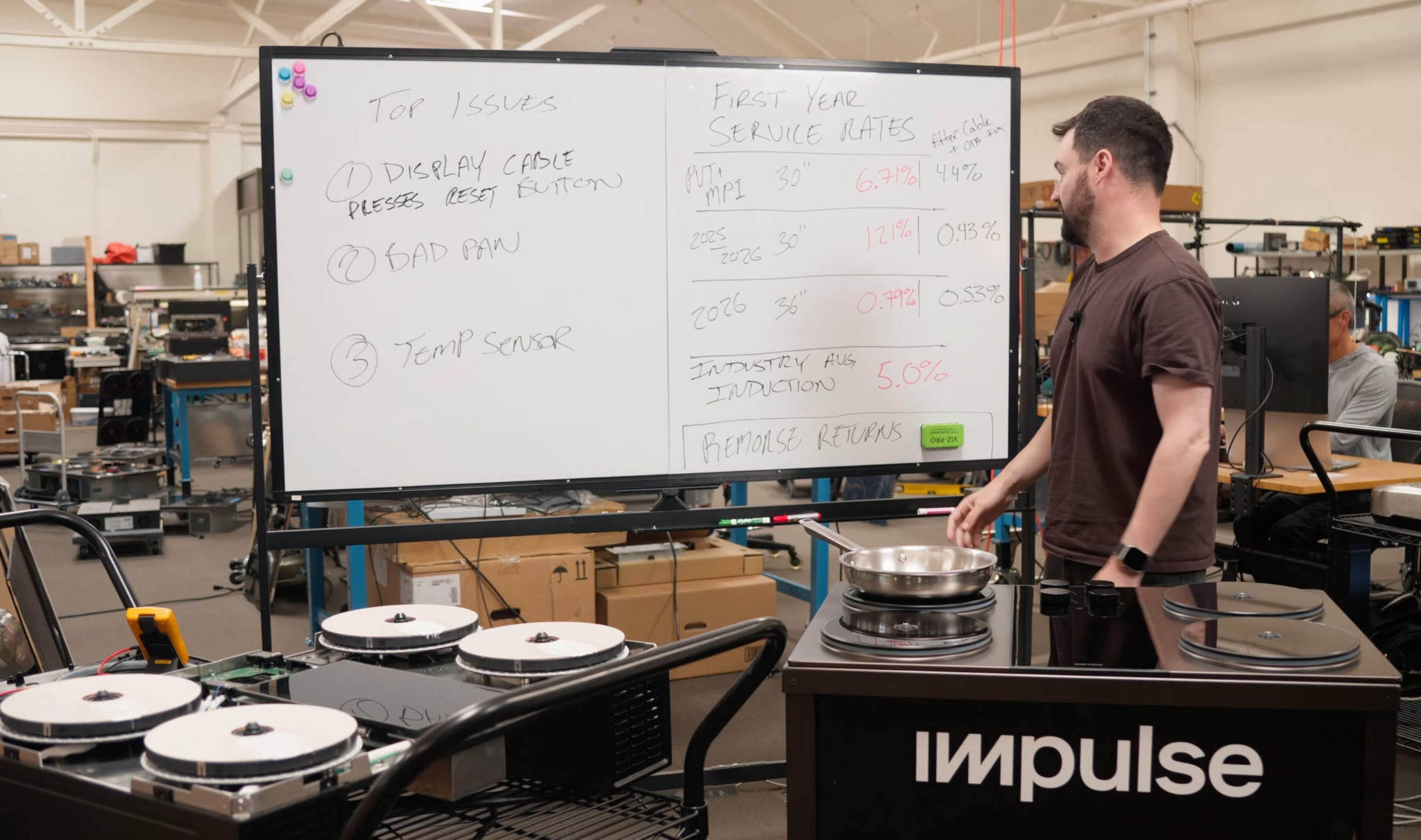
For a real look at The Brittle Lesson and how much engineering continues to occur even after a product ships, Impulse Labs breaks down a year of field failures on its battery-powered induction cooktop and the changes to design, manufacturing, and OTA software fixes that addressed them. These are failure modes that only reveal themselves once you’re shipping at volume.
Field Failure #1: A display cable holding the cooktop in reset. Assembly positioning and shipping vibration could wedge the display flex cable against a PCB reset button, preventing boot. The button was then disabled in subsequent firmware builds.
Field Failure #2: Pan-dependent control loop instability. Specific cookware sets had combinations of SS alloys and base-layer thicknesses whose magnetic properties changed with time and temperature at high power; this destabilized the induction drive’s control loops and caused internal failures. An OTA fix increased voltage checks from around 50 Hz to thousands of times per second, detecting the behavior before damaging voltage spikes and allowing operation at lower power.
Field Failure #3: Temperature sensor factory test escapes. As with many net-new custom components, the through-glass temperature sensor required refinement of its manufacturing processes and test coverage as field failures exposed what factory testing missed. More on the heat-flux sensing and control theory behind Impulse’s temperature sensor.
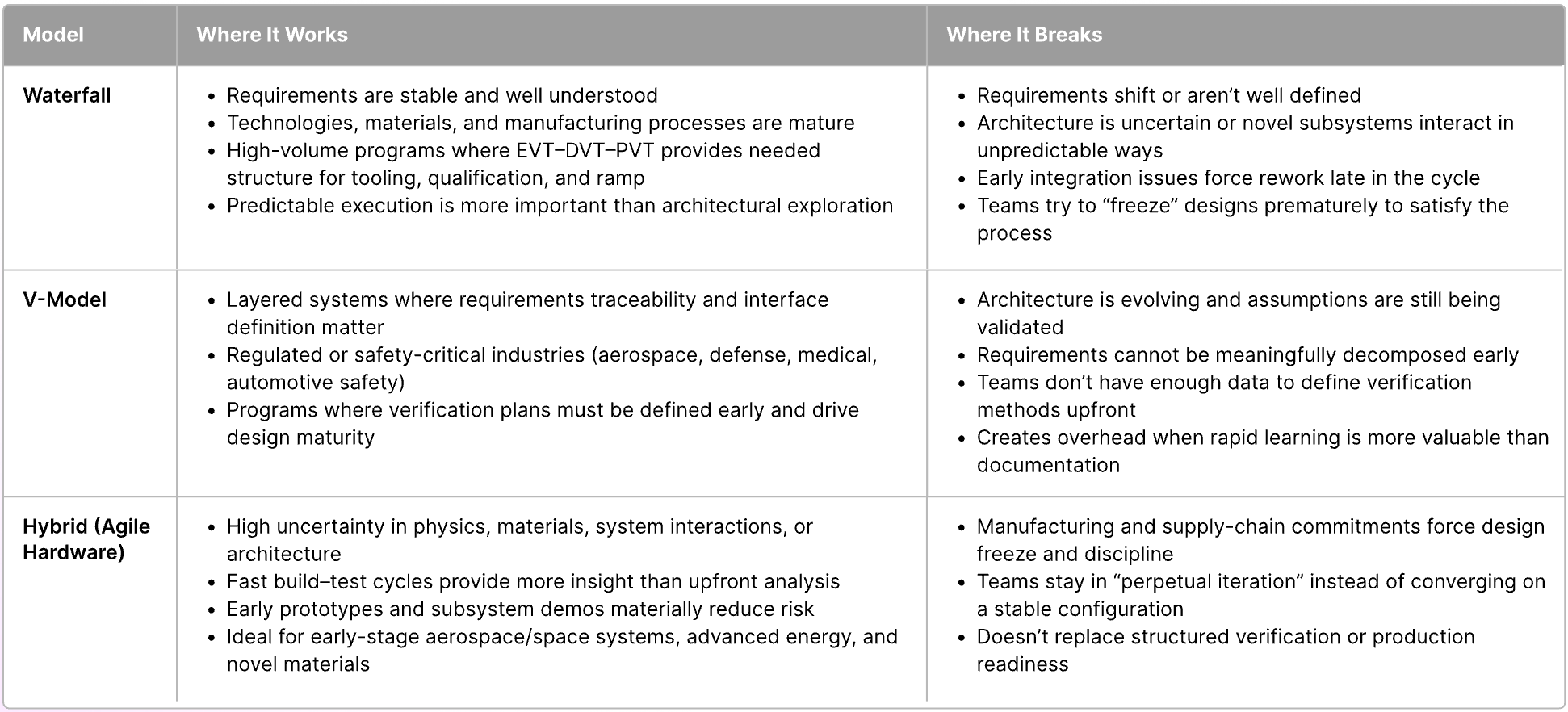
A guide to how engineering teams move from early prototypes to production across every major industry. Development often follows “stage-gate” processes, or build cadences with reviews of design progress, test resolves, and exit criteria between stages. The details may vary across aerospace, robotics, or automotive, but the goal is the same: define what a design must demonstrate before moving forward. Fun fact: Motorola is often credited with introducing the EVT–DVT–PVT sequence that became a standard framework for consumer hardware development.
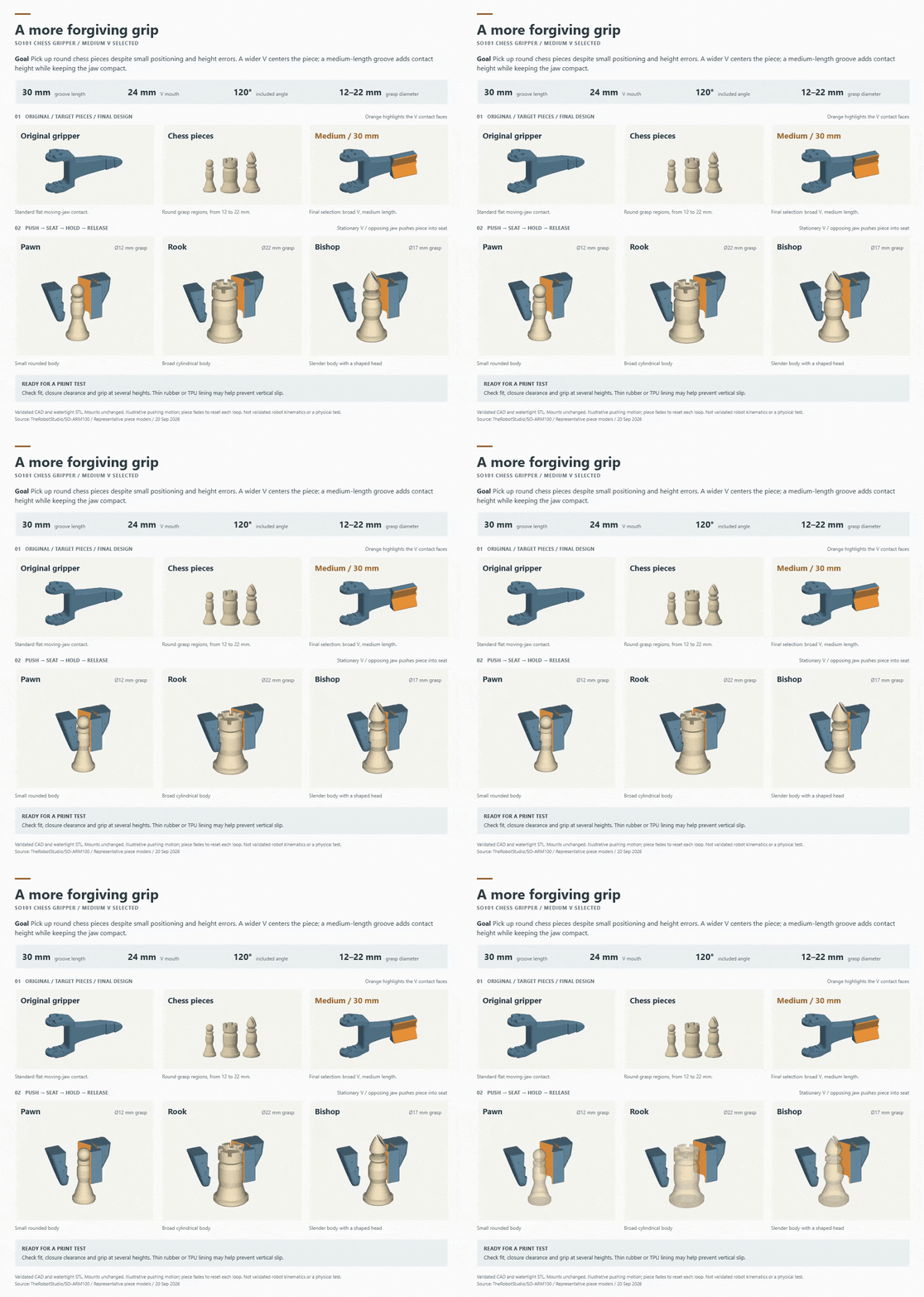
An example of spatial reasoning capabilities from the new frontier models: GPT-6 Astra designing a chess piece gripper for the SO-101 robot arm. The author’s prompt: Redesign the SO101 robot arm’s gripper to pick up chess pieces reliably, with a shape that centers round pieces and tolerates positioning errors. Refine the existing CAD, show the gripping action in an animated preview, and deliver the final STEP file for 3d printing. I'm going to lunch, don't stop for any reason until complete. Use computer use to send to Bambu H2S when complete.
A human brain contains 86 billion neurons, whereas smaller organisms like the fruit fly contain only 166 thousand. A 20-year research effort recently culminated in a complete wiring diagram of a male fruit fly’s central nervous system, mapping the connections between neurons in its brain and nerve cord. Naturally, this led to a flood of simulated ‘demos’ using the fly neural net to parallel park or play Beat Saber. These come with caveats: the Beat Saber model, for example, was overtrained on a single track. The connectome offers a neat way to explore how specialized neural architectures might punch above their weight on motor tasks compared with networks designed by humans.
A couple new events on our radar:
Instrumental is hosting their 3rd annual Build Better Electronics Summit (10/7), bringing together electronics engineering and operations leaders across AI infrastructure, consumer, and A&D. Expect candid conversations, cross-industry learning, and meaningful networking around today’s toughest manufacturing challenges, all aboard the USS Hornet aircraft carrier. Learn more and register.
A live workshop with Quilter (10/8) on whether there’s really a shortage of electrical engineers, with four engineering leaders across the US, Canada, and Europe comparing notes on which roles are hard to fill and what they’re doing to build their teams. Come join if you’re hiring, looking for a role, or just curious!
And one fun link to round out the week: math meets music.
Presented by Flow: Requirements Management and AI agents to align CAD, simulation, code, and test
You increase range by 10%. The battery pack grows. Now the mass budget’s off, the mount bolts need a new torque spec, and a few test cases are stale. Somewhere, a line of code still assumes the old pack. Reconciling all of this correctly takes days.
With Flow’s agents you find the downstream impacts that same afternoon, and changes are identified and pushed across the tools the engineers already use.
Thousands of engineers at Rivian, Stoke Space, Astranis, Intuitive Machines, and Joby use Flow to iterate faster while maintaining engineering rigor.

Startup News
Rainmaker raised a $100M Series B to expand its atmospheric research team and validate its cloud-seeding technology. The company builds drones that release silver iodide into clouds to help water droplets form rain or snow. Rainmaker reports test flights in Alaska’s Kenai Peninsula generated 19M gallons of precipitation over three hours. Investors included DCVC and Lowercarbon Capital, among others.
Crusoe announced the initial close of a planned $3.9B Series F at a $30.9B valuation to build more AI data centers and expand its cloud services. The company builds data centers, power infrastructure, and supplies computing capacity for AI workloads. It reports over 6 GW of contracted capacity, with 1 GW already operational.
Watney Robotics raised an $80M Series A to expand its fleet of robots for data-center operations. The robots perform tasks such as cable swaps and server restarts. Meta is currently testing its two-armed robots at data centers in Iowa and Ohio, though the trial is in early stages. The round was co-led by Valor Atreides AI Fund and Hummingbird Ventures.
SpaceX is targeting 9/28 for Starship’s first orbital mission in its 14th test flight. The rocket will attempt to deploy 26 Starlink V3 satellites into low Earth orbit. The upper stage is expected to circle Earth six times before splashing down off Chile roughly 10 hours after launch; the booster will make a controlled splashdown in the Gulf of Mexico.
Open Jobs
Describe your ideal role on our job board, and we’ll find matches. If you’re hiring, promote your open role here.
Early Career:
Eight Sleep is looking for a Mechanical Engineer and an Electrical Engineer (New Grad 2027) in San Francisco, CA
Mid-Level:
Normal Computing is looking for a Hardware Engineer, PCB in New York, NY ($200–400K)
Periodic Labs is looking for a Mechanical Engineer in Menlo Park, CA ($200–300K)
Senior to Staff:
Tesla is looking for a Sr. Process Integration Engineer, Terafab in Austin, TX
The American Housing Corporation is looking for a Head of Manufacturing Engineering in Austin, TX ($180–250K)
Tools From Our Sponsors
Design & Simulation
Duro — AI-native PLM that centralizes part data, manages change orders, and connects the whole stack so your team can focus on execution, not administration.
nTop – Computational design to accelerate product development.
Onshape for Startups – Free access to Onshape Professional or Onshape Government (compliant with ITAR/EAR) for hardware startups and entrepreneurs.
Manufacturing
Loombotic – Instant-quote custom wire harnesses. Upload drawings or design online, fast turnaround.
Xometry — Instant quoting on custom parts, from R&D prototypes to high-volume production runs.
Fictiv – On-demand custom manufacturing from prototype to production.
Access Every Link We’ve Ever Shared 🎞️
Refer three friends to Hardware FYI and unlock our full archive.
Missed an issue? Hunting for that one link? Every tool, guide, and article we’ve ever shared is in here.
P.S. If you find something interesting—an article, tool, funding round, project, really anything—send it our way.
P.P.S. 20,000+ engineers, founders, and operators read this newsletter. If you want to reach them, get in touch.