45 Laws for Spacecraft Design (and Life)
Topics worth your time: hard-earned lessons in spacecraft design (and life), tracing where AI capital spending goes, a case study on the limits of “vibe-manufacturing,” a tour of Starlink’s factory in Texas, and more.

Interesting Lecture Notes: Akin’s Laws of Spacecraft Design
Keeping up with the latest advances in engineering can at times feel like the field is iterating faster than anyone can fully evaluate it. Just as things may start to feel comfortable, there’s another round of new tools and capabilities, which can also be equal parts exhilarating and exhausting. It is, by any measure, an uncanny period when the frontier is moving faster than the understanding behind it.
This encroaching shift in the craft of engineering makes for a direct juxtaposition with safety-critical systems, where the margin for error hasn’t moved (and will not), and neither has the value of expertise earned over time and often the hard way.
Akin’s Laws of Spacecraft Design are 45 rules on engineering and project management, drawn from a career spent designing spacecraft and learning, by the author’s own account, what not to do. David Akin first wrote the list as a handout for his senior capstone design course; an abridged version now hangs framed in Mission Control at NASA Johnson Space Center.
These are some bits of wisdom that I have gleaned during that time, some by picking up on the experience of others, but mostly by screwing up myself. I originally wrote these up and handed them out to my senior design class, as a strong hint on how best to survive my design experience… — David Akin, Professor of Aerospace Engineering at the University of Maryland
Of the 45, a handful of favorites that hold as fundamental tenets of engineering.
Analysis and engineering:
1. Engineering is done with numbers. Analysis without numbers is only an opinion.
17. The fact that an analysis appears in print has no relationship to the likelihood of its being correct.
Understanding design requirements:
13. Design is based on requirements. There’s no justification for designing something one bit “better” than the requirements dictate.
3. Design is an iterative process. The necessary number of iterations is one more than the number you have currently done. This is true at any point in time.
Schedules:
23. The schedule you develop will seem like a complete work of fiction up until the time your customer fires you for not meeting it.
33. (Patton’s Law of Program Planning) A good plan violently executed now is better than a perfect plan next week.
The full list is worth reading in its entirety, with additional meta-commentary on each law. For a manufacturing specific companion, the University of Florida’s 110 Tips for DFMA covered in a past issue pairs well.
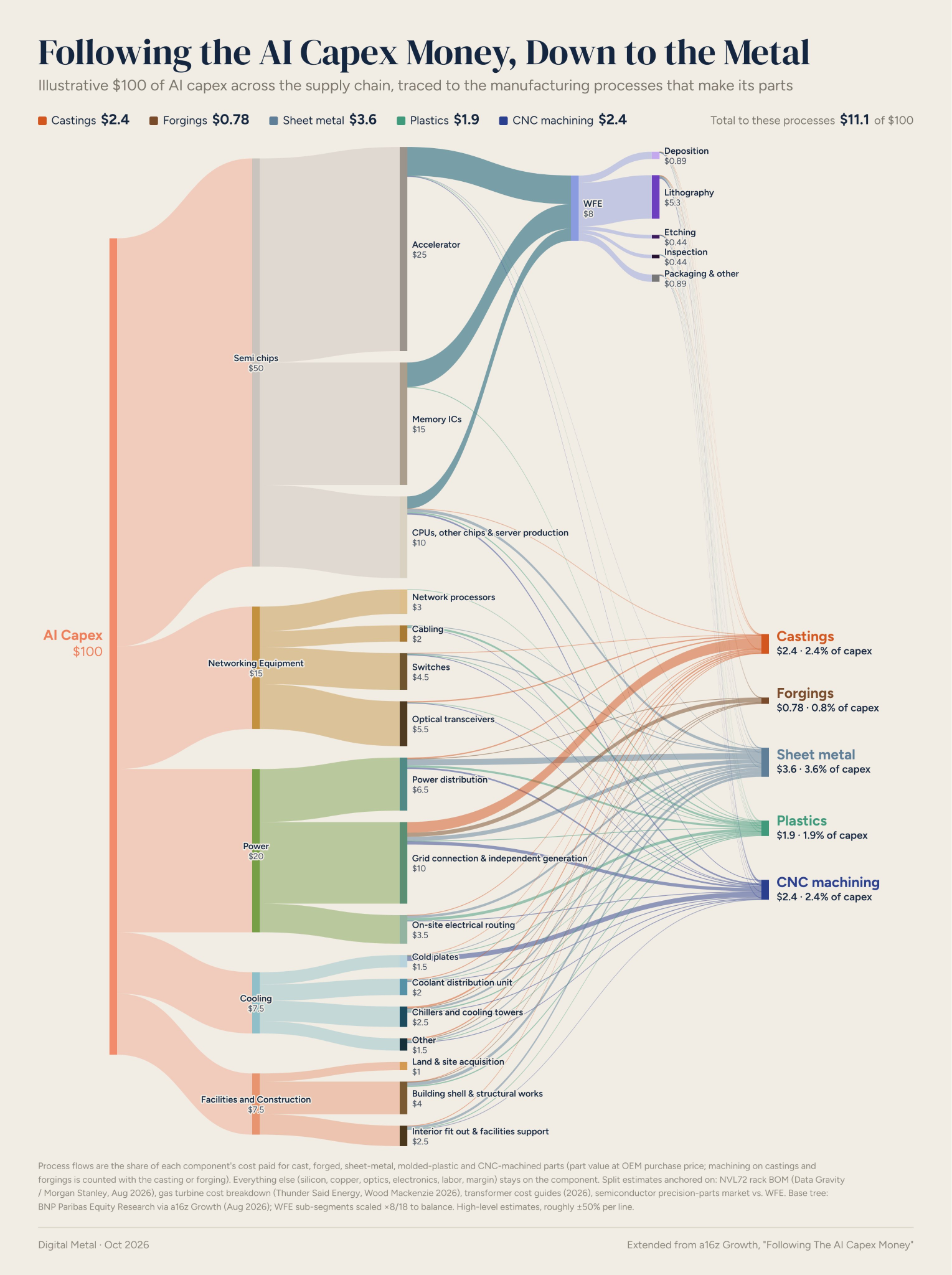
Interesting Diagram: Tracing AI Capex
From a16z’s State of Markets II - tracing the full AI capital expenditure supply chain.
Presented by Normal: Why AI Inference Needs New Hardware
LLM decoding is memory-bound: for every token, the processor re-reads weights that have not changed, and the attention cache grows with the context. Normal Computing is building inference hardware that runs a model’s heaviest operations inside the memory itself, where the weights are already stored.
Processing-in-memory is a long-pursued answer, but noise has long been a challenge; Normal’s thermodynamic primitive treats that noise as a computational resource. CN101, the first thermodynamic computing chip, runs generative models natively on-chip, with results presented at Hot Chips 2026. Chief Scientist Patrick Coles explains why inference needs new hardware.

More From Around the Web
A case study from a bootstrapped device manufacturer on why “vibe-manufacturing” is still wishful thinking.
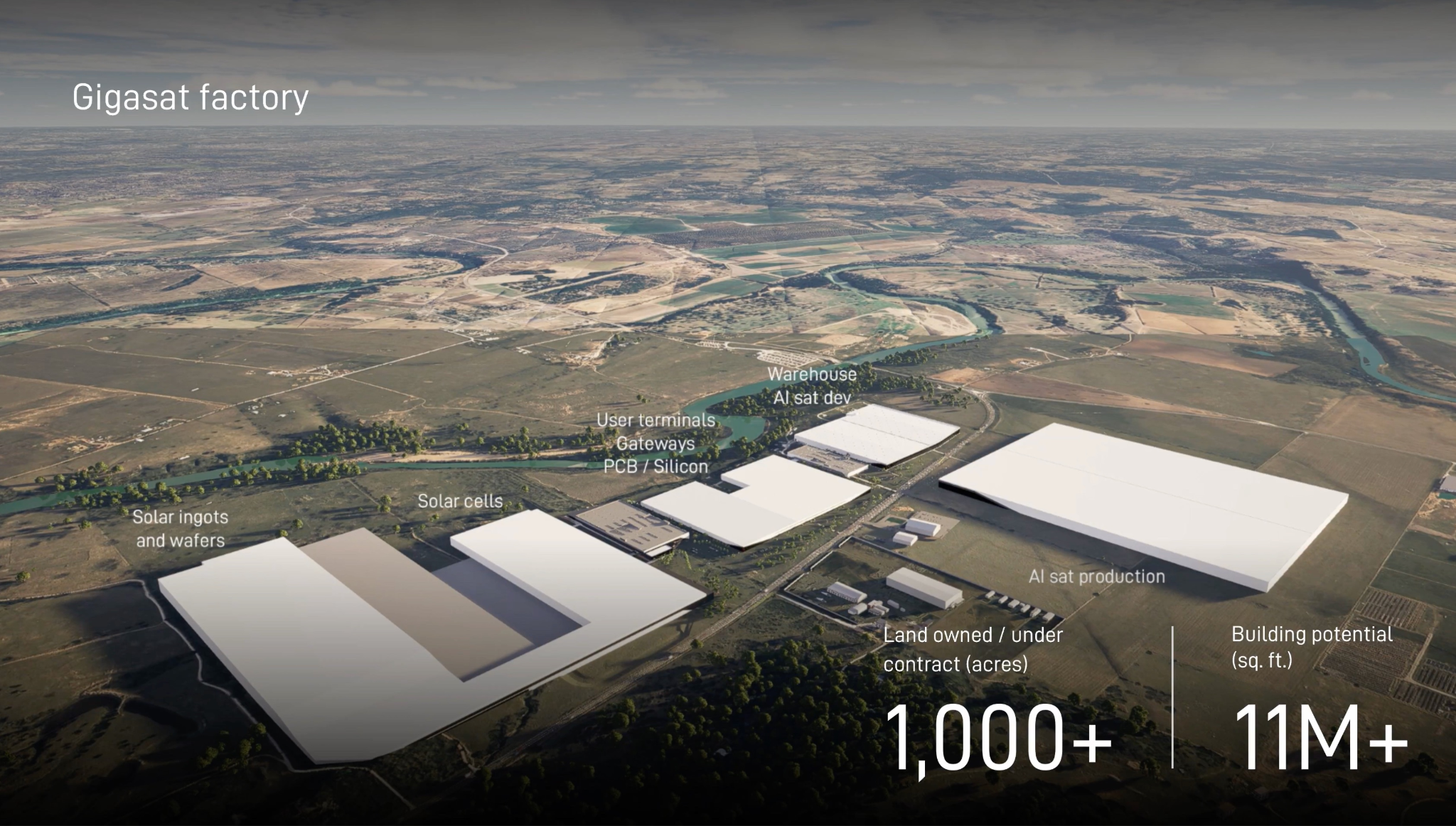
On the other end of the spectrum: a video walkthrough of Starlink’s factory in Bastrop, TX - already (or soon to be) North America’s largest PCB facility.
An inside look at Valar Atomics’ dispute with an early investor and the specific funding terms (“spring back” pro rata) behind the fallout.
NASA’s Fastener Design Manual from March 1990.
A good engineering book list. On a related note, John Carreyrou’s Bad Blood: Secrets and Lies in a Silicon Valley Startup has us looking forward to the new Theranos documentary.
Manufacturing & Startup News
Atomic Machines emerged from stealth with $250M raised to date and a manufacturing system that builds micro-machines (likely a derivation of MEMS manufacturing) directly from code.
Kapta Space raised a $24M Series A to scale production of e-steered satellite radar payloads designed to track moving targets across land, air, and sea.
DoorDash unveiled DoorDash Air, a drone delivery system with automated loading and routing; pilots are planned with Chipotle and Popeyes.
The Pentagon announced $350M in new awards and programs for quantum computing, including a $150M loan commitment for PsiQuantum’s U.S. based manufacturing and prototyping and $200M for DARPA to test four companies’ quantum computing hardware.
Bloom raised a $3.6M seed round for its marketplace connecting hardware companies with manufacturing and engineering suppliers.
Tools From Our Partners
Xometry - Instant quoting on custom parts, from R&D prototypes to high-volume production runs.
Aris Machina Protos – Design & validate anything, with the AI-native workspace for industrial science and hardware R&D.
SolidWorks for Startups – Full access to SolidWorks’ product development tools, free for early-stage startups.
Zoo – AI-native CAD with a modern geometry engine, readable code, and editable feature trees for precise, editable models.
Trace.Space - The AI harness for hardware R&D.
Access Every Link We’ve Ever Shared 🎞️
Refer three friends to Hardware FYI and unlock our full archive.
Missed an issue? Hunting for that one link? Every tool, guide, and article we’ve ever shared is in here.
P.S. If you find something interesting—an article, tool, funding round, project, really anything—send it our way!
P.P.S. 20,000+ engineers, founders, and operators read this newsletter. If you want to reach them, get in touch.