$399 Robot, $412 Worth of Servos
Topics worth your time: the actuators and RL software behind Hugging Face’s Microduck, banned materials and manufacturing processes in Formula 1, why promising battery technology doesn't always make a viable business, and how Sony improves image quality without changing the hardware.
P.S. We’re hard at work on our SF Tech Week event on 10/09 - register here!

Interesting Links
Hugging Face’s Microduck is a walking robot that beyond its initial appeal as an interactive toy, offers a useful look at the changing landscape of robotics software development. Specifically, the robot’s movements (programmed and learned) come from reinforcement learning policies trained on thousands of simulated copies of the robot, then transferred to the physical body in a process known as sim2real. This breakdown of its actuators shows what the policies control: 15 Dynamixel XL330 servos, 14 in the learned policy space and one for the beak; public training files call out the M288-T variant which packs a motor, 288:1 plastic gearbox, encoder, driver, position loop, and bus interface into an 18g package. For anyone taught classical control theory, the underlying concepts are still recognizable. Each actuator uses conventional position feedback, but now a reinforcement-learning policy sits above those loops and coordinates targets for the entire body at 50 Hz. RL now does much of the gait design that used to be written out as trajectories and gains, while the remaining modeling work goes into making the simulator faithful enough for that policy to run on hardware.
On the supply-chain side: 10k+ preorders represent 150k+ servos, roughly 70% of its supplier’s annual actuator sales. Also notable: the 15 Dynamixel servos retail for about $412 on their own, against a $399 retail price.
An interesting way to view Formula 1 is as an exercise in engineering at the limits, with its technical regulations spelling out which banned materials and manufacturing processes push those limits too far. Spaceflight, elite motorsports, and professional cycling all operate in an engineering regime where performance is king. These conditions drive massive innovation, but can also encourage dangerous design choices and runaway costs. Formula 1’s 2026 restrictions include:
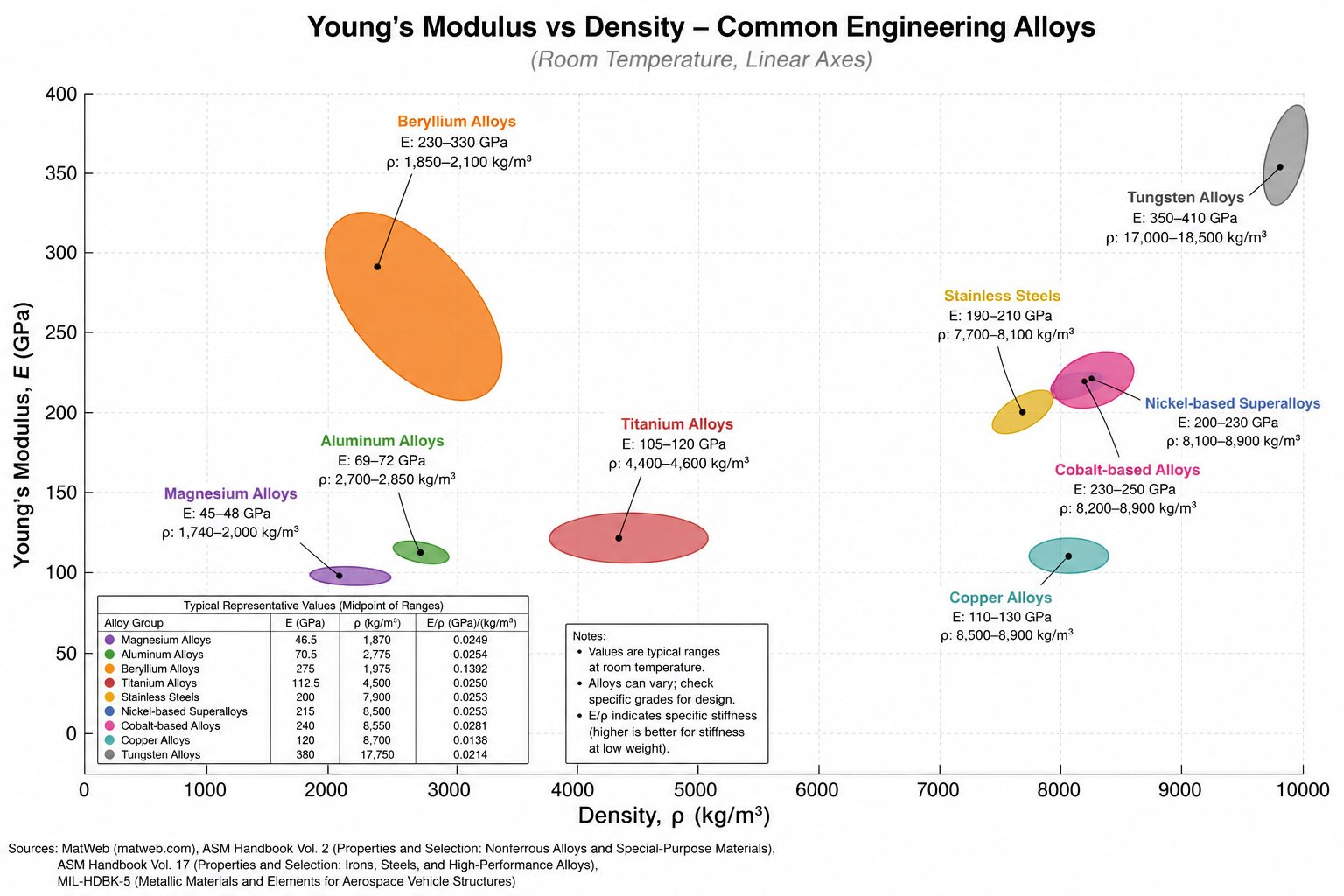
Beryllium in additive manufacturing: One of the highest stiffness-to-weight ratios of any metal, but toxic dust makes manufacturing hazardous (irreversible lung disease).
Nitinol shape memory alloys: Can return to a programmed shape when heated, opening the door to passive changes in aerodynamic geometry.
Metal matrix composites: Metals reinforced with ceramic particles or fibers, with a potentially enormous cost ceiling. Banned with limited exceptions.
Magnesium alloys inside the power unit: Low weight, but a serious fire risk. Permitted elsewhere on the car.
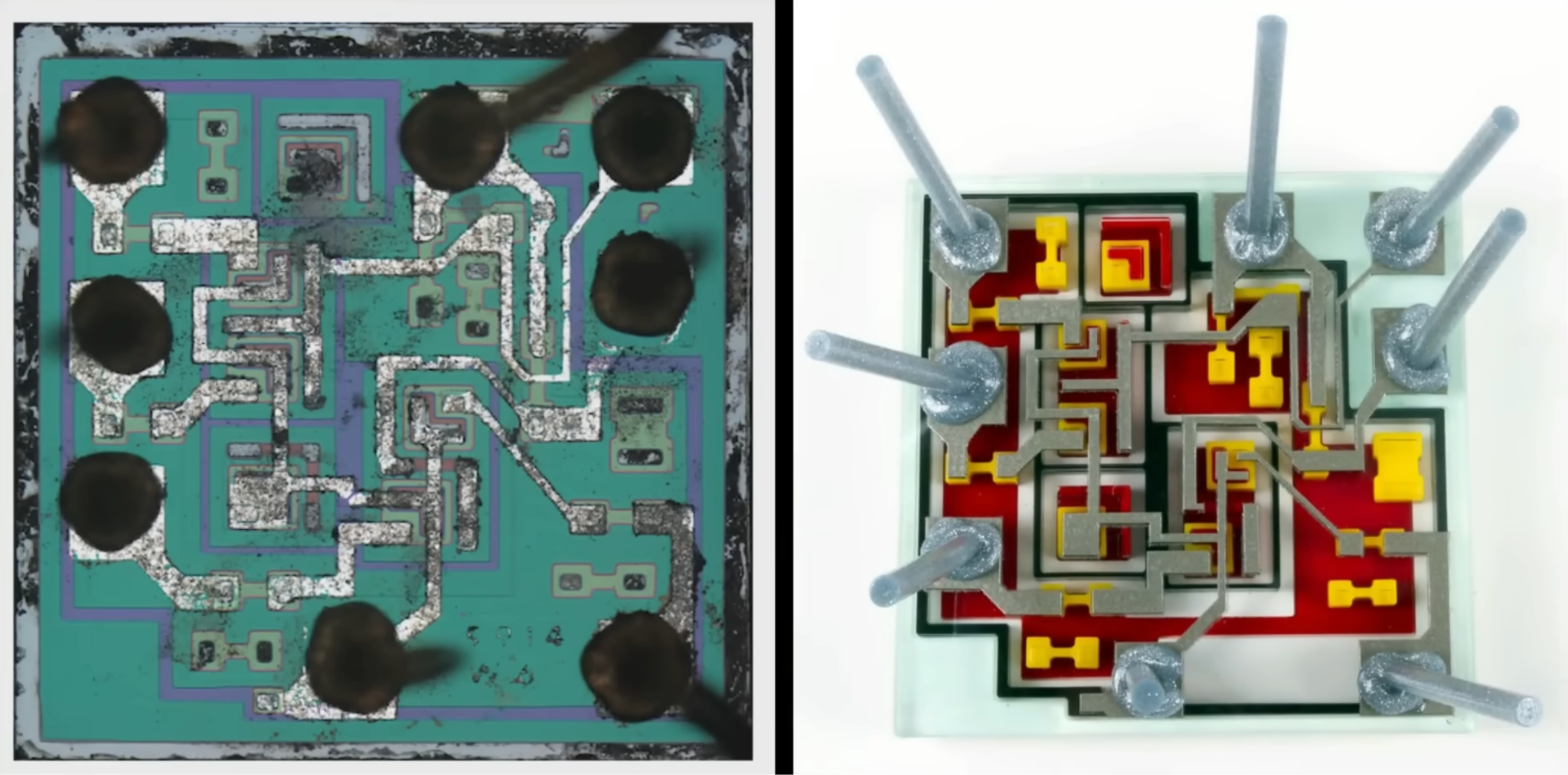
Demystifying How Chips are Built and How They Work is a 5-minute introduction to integrated circuits, turning an old dual input NOR gate (Fairchild μL914) into an acrylic model that traces how components connect together. Modern chips have so much detail (80 billion transistors in NVIDIA’s H100, compared to six in the μL914) that peering at a small region doesn’t reveal much about the global functionality of the device. Regardless, the whole IC relies on the same fundamental binary logic. Here, you can follow the logic of a NOR gate by hand: either input going high turns on a transistor that pulls the output low. Full written walkthrough here and for a refresher on logic gates, SparkFun has a useful digital logic primer.
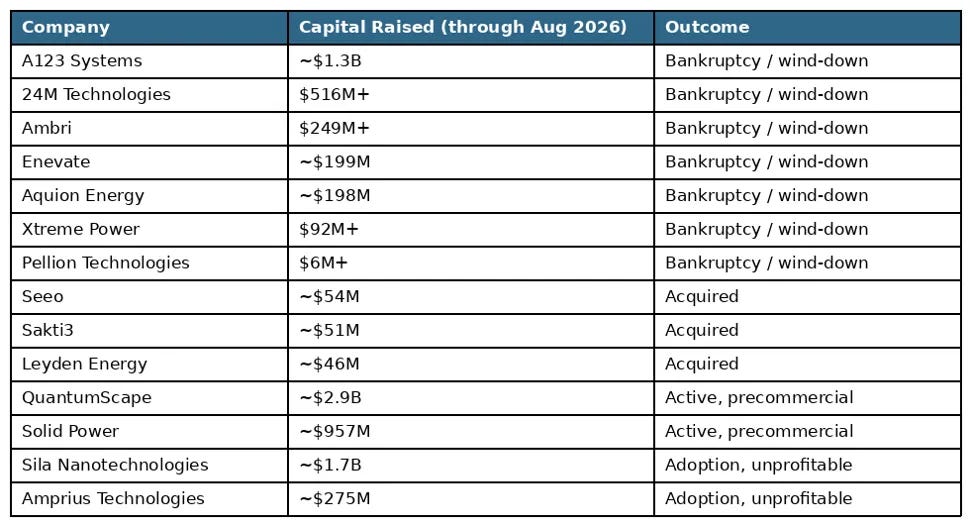
An investor’s take on why battery startups often fail to turn promising technology into commercially viable products. Battery startups over the last 20 years have often been able to partner with large original equipment manufacturers (OEMs) and obtain massive funding to spin up manufacturing. Some have even gone public and deployed batteries in commercial systems. However, very few have achieved durable commercialization and none have (yet) demonstrated economically sustainable operations. While there are myriad reasons for this, one is particularly relevant to all deep tech ventures: don’t lose sight of the metrics that matter. A higher Technology Readiness Level (TRL) of the battery or a pilot with a major company may help attract investors, but neither necessarily translates into a viable business. The authors point to the incremental approach of Asian battery manufacturers: sell into smaller markets first, use revenue and field data to improve the product/manufacturing process, and build toward larger markets.
An interesting presentation on how Sony improved image quality and temporal stability in PSSR through software alone without changing the PS5 Pro hardware. PlayStation Spectral Super Resolution, or PSSR, is Sony’s machine-learning upscaler which reconstructs a higher-resolution image from a lower-resolution render. In one demo, it reconstructs a 4K image from a 720p input.
And a couple of fun links to round out the week:
From Maker Faire Tokyo - message in a bottle, assembled and soldered (!) entirely inside the bottle.

A first look at Tesla’s Cybercab deployment in service around Austin, TX.
DigiKey has a deep library of free digital magazines covering everything from sensors, embedded systems, power electronics, to workbench tips.
A public teardown of Unitree G1’s knee actuator with measurements and photos of nearly every component inside.
Presented by Quilter: What if AI Could Lay Out Your Entire Board?
Quilter is enterprise-grade, physics-driven AI that automates PCB layout. Engineers upload a schematic and board outline, and Quilter handles component placement and routing end to end, turning weeks of manual work into hours while keeping engineers in full control.
Unlike legacy autorouters or LLM-based tools, Quilter reasons from the physics of the board to produce complete layouts in your native ECAD format, applying physics checks as each candidate is built. Manual PCB layout often runs longer than planned, setting the pace for everything downstream.

Startup News
Lumafield announced a foundation model trained on industrial CT scans that groups manufactured parts by similarities in their internal structure. Examples included identification of different chipsets and replacement batteries in aftermarket iPhones, and indistinguishable battery cells sold under two brands. On one connector PN, the company reported 98.8% accuracy distinguishing genuine units from open-market equivalents.
Lyte raised a $165M Series C at a $1.6B valuation to increase silicon production and deploy its perception system in more robots. Founded by former Apple engineers who worked on Face ID, the company’ system combines camera images, inertial motion sensing, and distance/velocity readings into a single data feed. The round was led by Maverick Silicon.
Reframe Systems raised $40M in new funding to expand its network of robotic homebuilding factories across North America. The company has completed 10 homes and plans to open a Massachusetts factory designed to produce up to 500 multifamily units or 250 single-family homes annually. The round was led by Energy Impact Partners.
SpaceX announced plans to invest $100B in a Louisiana spaceport for Starship, with construction scheduled to begin in 2027 and first launches targeted for 2029. The site will include 10 launch pads across five complexes, along with on-site propellant production, power generation, and deep-water shipping.
Open Jobs
More jobs added weekly on our job board. If you’re hiring, promote your open role here.
Sponsored:
Springcraft is looking for a Manufacturing Engineer in Palo Alto, CA
Early Career:
Micron Technology is looking for an Electrical Failure Analysis Engineer in Boise, ID
Hadrian is looking for a Robotics Engineer Intern in Los Angeles, CA
Mid-Level:
1X is looking for a CAD Modeler in San Carlos, CA
Senior to Staff:
ASML is looking for a Senior Electrical Engineer in Wilton, CT
ŌURA is looking for a Director of Sustainability in San Francisco, CA
Tools From Our Sponsors
Design & Simulation
Duro — AI-native PLM that centralizes part data, manages change orders, and connects the whole stack so your team can focus on execution, not administration.
nTop – Computational design to accelerate product development.
Onshape for Startups – Free access to Onshape Professional or Onshape Government (compliant with ITAR/EAR) for hardware startups and entrepreneurs.
Manufacturing
Loombotic – Instant-quote custom wire harnesses. Upload drawings or design online, fast turnaround.
Xometry — Instant quoting on custom parts, from R&D prototypes to high-volume production runs.
Fictiv – On-demand custom manufacturing from prototype to production.
Access Every Link We’ve Ever Shared 🎞️
Refer three friends to Hardware FYI and unlock our full archive.
Missed an issue? Hunting for that one link? Every tool, guide, and article we’ve ever shared is in here.
P.S. If you find something interesting—an article, tool, funding round, project, really anything—send it our way.
P.P.S. 20,000+ engineers, founders, and operators read this newsletter. If you want to reach them, get in touch.